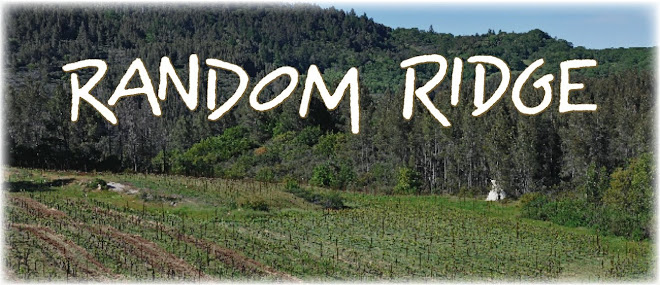
"A Winery Fights to Keep Topsoil" by George Snyder
... 'We don't want erosion and we don't want to use pesticides and herbicides here,' Hawley says. 'I guess the bottom line is that we want to hold onto the soil. It's that fine, red, volcanic stuff that gives our grapes their distinctive taste. The French call it the 'taste of the earth.' It's something we just don't want to lose.'
Tuesday

Sonoma Index-Tribune, october 1985
John Lynch, "Poet and grape grower honored for vineyard control efforts here"
"Bill Hawley earned his college degree in Contemporary Poetry. But he has developed equal talent in expressing his work with his hands... Hawley, 33,... has been selected as 1984 "Cooperator of the Year" by the Sonoma Valley Resource Conservation District for his efforts to control hillside vineyard erosion."
"Bill Hawley earned his college degree in Contemporary Poetry. But he has developed equal talent in expressing his work with his hands... Hawley, 33,... has been selected as 1984 "Cooperator of the Year" by the Sonoma Valley Resource Conservation District for his efforts to control hillside vineyard erosion."
San Francisco Chronicle
Rod Smith, The Wine Page, "A Fine Crew of California Zinfandels Ages Well", april 1989,
It could only be described as a fine Zinfandel in its prime. That was the case with the 1979 Quantum Leap, made by Sonoma County grapegrower William Hawley from his own vineyard in the Mount Veeder area. As a dry late harvest wine, it showed another classic zin style that is unique to the variety. Inky purple and very, very ripe, it showed volcanic Zinfandel flavors and a dusting of black pepper in the long finish.
It could only be described as a fine Zinfandel in its prime. That was the case with the 1979 Quantum Leap, made by Sonoma County grapegrower William Hawley from his own vineyard in the Mount Veeder area. As a dry late harvest wine, it showed another classic zin style that is unique to the variety. Inky purple and very, very ripe, it showed volcanic Zinfandel flavors and a dusting of black pepper in the long finish.
Press Democrat
Dan Berger's Wine Cellar, september 1994
"Some of the best new labels on the shelf are from newcomers who have developed new wineries on existing vineyards. Among these are excellent producers with names such as ... Random Ridge... Today adventuresome consumers can have good, fairly priced wine in almost every price range -- wine that's better than it's ever been."
"Some of the best new labels on the shelf are from newcomers who have developed new wineries on existing vineyards. Among these are excellent producers with names such as ... Random Ridge... Today adventuresome consumers can have good, fairly priced wine in almost every price range -- wine that's better than it's ever been."
Wine Enthusiast
Unknown Sonoma by Dan Berger, august 1996
Random Ridge: Surfer Bill Hawley began to make wine a decade ago from his own six-acre vineyard high in the Mayacamas Mountains. The vineyard, now 10 acres, is on Mount Veeder, accessible through a remote Sonoma Valley road. "The Napa/Sonoma county line goes right through my property; my house is in both counties," he says.
Hawley's production, including a joint venture with Wellington, is 700 cases. The Random Ridge red wine is a 50-50 Cabernet Sauvignon/Franc blend; Wellington uses Random Ridge as a vineyard designate. About 90 percent of Hawley's wine is sold "within an hour's drive of my home." He also makes Old Wave Zinfandel from a 90-year old Sonoma Valley vineyard and a tiny amount of Cloudbreak Chardonnay.
Hawley moved here in 1972 to attend Sonoma State University (and wrote a thesis on the influence of Zen Buddhism on the San Francisco school of poetry), built his own home, hand-embellishes each wine label, farms all the grapes he uses.
Random Ridge: Surfer Bill Hawley began to make wine a decade ago from his own six-acre vineyard high in the Mayacamas Mountains. The vineyard, now 10 acres, is on Mount Veeder, accessible through a remote Sonoma Valley road. "The Napa/Sonoma county line goes right through my property; my house is in both counties," he says.
Hawley's production, including a joint venture with Wellington, is 700 cases. The Random Ridge red wine is a 50-50 Cabernet Sauvignon/Franc blend; Wellington uses Random Ridge as a vineyard designate. About 90 percent of Hawley's wine is sold "within an hour's drive of my home." He also makes Old Wave Zinfandel from a 90-year old Sonoma Valley vineyard and a tiny amount of Cloudbreak Chardonnay.
Hawley moved here in 1972 to attend Sonoma State University (and wrote a thesis on the influence of Zen Buddhism on the San Francisco school of poetry), built his own home, hand-embellishes each wine label, farms all the grapes he uses.
Los Angeles Times
"Former 'longhairs' true to their environmental roots", Dan Berger
"Thirty years ago, when the counter-culture staged sit- in protests and raged about the environment -- and middle America called them kooks -- some "longhairs," frustrated at intransigence in the establishment, moved to northern California.
Many wound up in the then-little-populated California counties of Napa, Sonoma, and Mendocino... the growth of the California wine industry in the early 1970's coincides with the move of disaffected city-dwelling, environmentally conscious youth to the hinterlands, many of whom wound up in the wine industry.
In the last decade, some have reverted to their original philosophy and adopted the organic farming methods that are proving effective for the making of fine wine.
... With tiny wineries such as Random Ridge in the Napa Valley... full organic farming is in full effect."
"Thirty years ago, when the counter-culture staged sit- in protests and raged about the environment -- and middle America called them kooks -- some "longhairs," frustrated at intransigence in the establishment, moved to northern California.
Many wound up in the then-little-populated California counties of Napa, Sonoma, and Mendocino... the growth of the California wine industry in the early 1970's coincides with the move of disaffected city-dwelling, environmentally conscious youth to the hinterlands, many of whom wound up in the wine industry.
In the last decade, some have reverted to their original philosophy and adopted the organic farming methods that are proving effective for the making of fine wine.
... With tiny wineries such as Random Ridge in the Napa Valley... full organic farming is in full effect."
Subscribe to:
Posts (Atom)
